
For two decades, Bugatti’s flagship hypercars were built around a single idea: the quad-turbocharged W16 engine. The 2026 Tourbillon breaks from that tradition entirely, replacing the Veyron and Chiron’s signature powerplant with a naturally aspirated V16 hybrid system developed alongside Cosworth. It’s the first genuinely new Bugatti in over 20 years, and it arrives with numbers that push the hypercar category into new territory.
Table of Contents
- Overview
- Exterior Design
- Interior and Cabin Craftsmanship
- Engine and Powertrain
- Horsepower and Torque
- Performance
- Chassis and Suspension
- Technology
- Pricing and Exclusivity
- Competitors
- Pros and Cons
- Final Verdict
Overview
The 2026 Bugatti Tourbillon is a mid-engine hybrid hypercar that replaces the Chiron as Bugatti’s flagship model. It takes its name from the tourbillon, a mechanism used in high-end mechanical watches to improve accuracy against the effects of gravity, a fitting reference given the car’s watchmaker-built instrument cluster. Production is capped at 250 units worldwide, with every example bespoke-commissioned through Bugatti’s atelier program and deliveries expected to begin in late 2026.
Exterior Design
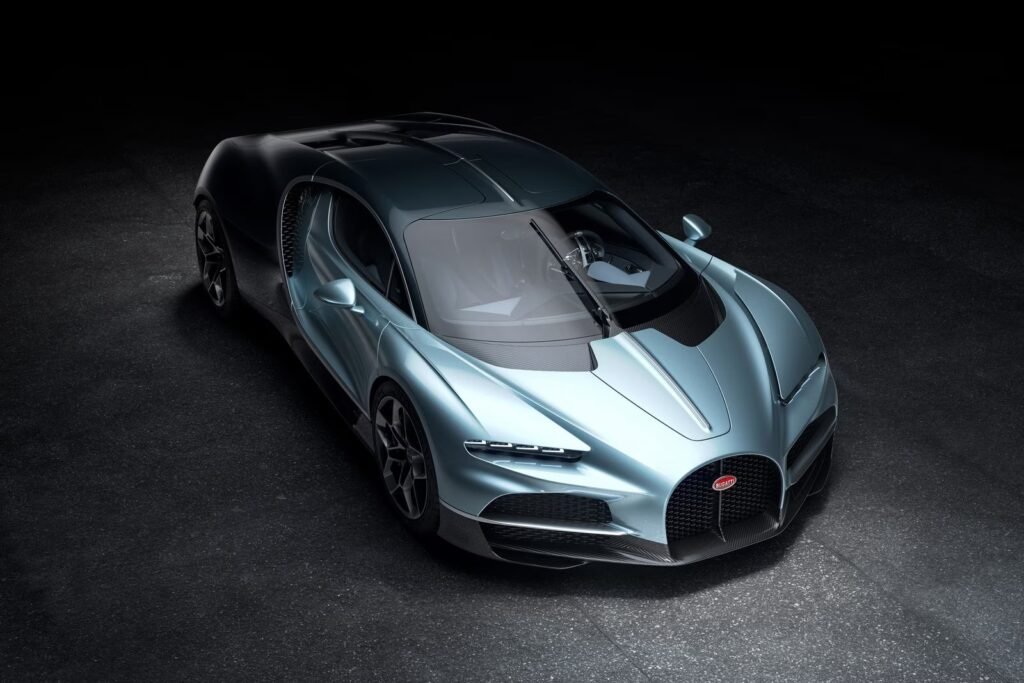
The Tourbillon retains a silhouette that’s recognizably Bugatti, built around the brand’s four core design elements: the horseshoe grille, the Bugatti line, the central ridge, and the signature dual-color paintwork split. Compared to the outgoing Chiron, the Tourbillon is narrower and roughly four centimeters lower, giving it a more aggressive stance and improved aerodynamics. Self-opening dihedral doors rise upward to preserve the car’s aerodynamic profile while easing entry and exit, and a striking unbroken taillight design, inspired by the shape of a peregrine falcon in flight, vents hot air from beneath the rear of the car.
Interior and Cabin Craftsmanship
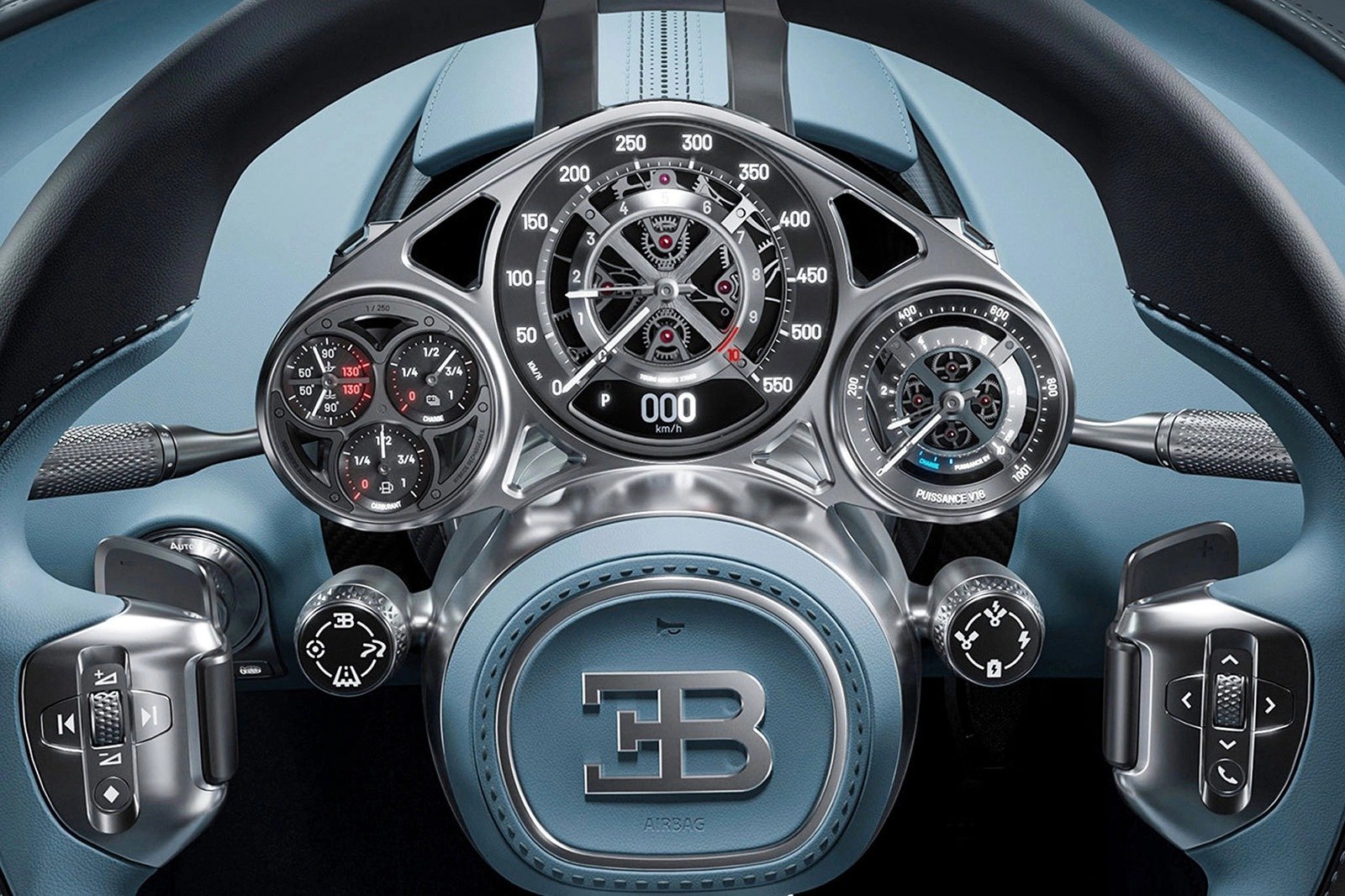
Rather than lean on large digital displays, Bugatti built the Tourbillon’s cabin around an entirely analog instrument cluster, crafted by Swiss watchmaker Concepto from titanium and set with gemstones including sapphire and ruby. The cluster is made up of more than 600 individual components and sits at the center of a fixed-hub steering wheel, where only the outer rim rotates, ensuring the display remains visible at all times. A center touchscreen does exist for navigation and connectivity, but it retracts into the dashboard when not needed, keeping the cabin’s design timeless rather than tied to today’s screen technology. To achieve the lowest possible seating position, the seats are mounted directly to the floor, with the pedals and steering column adjusting instead.
Engine and Powertrain
At the heart of the Tourbillon is an entirely new 8.3-liter naturally aspirated V16 engine, codeveloped with Cosworth and weighing approximately 555 pounds. Unlike the quad-turbocharged W16 that powered the Veyron and Chiron, Bugatti chose natural aspiration deliberately, prioritizing a higher rev ceiling and a more visceral driving experience over outright boost. The engine revs to a screaming 9,000 rpm and works alongside three electric motors, two mounted on a front e-axle and one at the rear, drawing power from a 24.8-kWh battery integrated directly into the car’s carbon monocoque.
Horsepower and Torque
The V16 alone produces 986 horsepower and roughly 664 lb-ft of torque, while the three electric motors contribute a further 789 horsepower, for a combined output of 1,775 horsepower. That figure comfortably surpasses even the most powerful Chiron Super Sport variants, despite the Tourbillon weighing less than its predecessor thanks to extensive use of 3D-printed components and lightweight carbon construction.
Performance
Bugatti says the Tourbillon will accelerate from 0-62 mph in under two seconds, with 0-124 mph arriving in under five seconds and 0-186 mph in under ten. Top speed is electronically limited to 248 mph in normal use, but with the special Speed Key engaged on a closed circuit under the right conditions, the Tourbillon is capable of reaching 276 mph, putting it among the fastest production cars ever built. On the electric side, the battery allows up to 37 miles of silent, all-electric driving, useful for slipping quietly through city centers before unleashing the V16.
Chassis and Suspension
The Tourbillon’s chassis is built from T800 carbon composite, with the battery pack integrated into the monocoque as a structural element to save weight, and a rear diffuser doing double duty as part of the car’s crash structure in place of a traditional rear crash beam. Suspension duties are handled by a forged aluminum multi-link setup, developed in collaboration with Divergent Technologies, the parent company of Czinger, using AI-assisted, organically shaped 3D-printed components that Bugatti says are 45 percent lighter than the equivalent system on the Chiron.
Technology
Despite its analog-first interior philosophy, the Tourbillon isn’t short on technology. The retractable center touchscreen handles modern conveniences like navigation and phone connectivity, while the watchmaker-built instrument cluster represents a level of mechanical craftsmanship rarely seen in a production vehicle. Bugatti’s engineering also extends to advanced 3D-printing techniques used throughout the chassis and suspension, blending traditional coachbuilding philosophy with genuinely cutting-edge manufacturing methods.
Pricing and Exclusivity
Bugatti has set the Tourbillon’s base price at €3.8 million before taxes and options, which converts to somewhere between roughly $4.1 million and $4.6 million depending on when the currency conversion is calculated and how exchange rates move. Given Bugatti’s extensive bespoke personalization program, most buyers are expected to spend considerably more once custom paint, unique interior trim, and one-of-one specifications are factored in. With only 250 units planned and most or all build slots reportedly already allocated to buyers globally, actual transaction prices and availability will vary significantly by market.
Competitors
The Tourbillon sits at the very top of the hypercar market, competing against a small handful of similarly exclusive machines, including the Pagani Utopia and Koenigsegg Jesko. The Aston Martin Valkyrie is perhaps its closest hybrid rival, sharing a similar philosophy of pairing extreme performance with electrification, and notably uses a hybrid battery system supplied by Rimac, the company now led by Bugatti’s own CEO, Mate Rimac.
Pros and Cons
Pros
- Combined 1,775 horsepower from a genuinely novel naturally aspirated V16 hybrid powertrain
- Watchmaker-crafted analog instrument cluster is unlike anything else in the automotive world
- Up to 37 miles of silent electric-only driving range
- Extensive bespoke customization through Bugatti’s atelier program
Cons
- Base price of roughly $4.1 to $4.6 million puts it firmly out of reach for all but a handful of collectors
- Limited production of 250 units means most enthusiasts will never see one in person, let alone drive one
- Reaching the full 276 mph top speed requires a special Speed Key and closed-circuit conditions
- Small 24.8-kWh battery limits electric-only range compared to dedicated EVs
Final Verdict
The 2026 Bugatti Tourbillon represents one of the most significant hypercars of the modern era, not just for its staggering performance figures but for the philosophy behind them. By choosing a high-revving naturally aspirated V16 over forced induction, and pairing it with genuine watchmaking craftsmanship in the cabin, Bugatti has built a car that feels deliberately, defiantly analog even as it embraces hybrid electrification under the surface. It’s a car almost nobody will ever own, but as a statement of what’s possible at the absolute pinnacle of automotive engineering, the Tourbillon delivers in a way few other vehicles ever will.
Frequently Asked Questions
1. How much does the 2026 Bugatti Tourbillon cost? Bugatti’s base price is set at €3.8 million before taxes and options, which translates to roughly $4.1 million to $4.6 million depending on exchange rates. Most buyers are expected to pay considerably more once bespoke customization options are added.
2. How much horsepower does the Bugatti Tourbillon have? The Tourbillon produces a combined 1,775 horsepower, with 986 horsepower coming from its naturally aspirated 8.3-liter V16 engine and the remaining 789 horsepower supplied by three electric motors.
3. What is the top speed of the Bugatti Tourbillon? Top speed is electronically limited to 248 mph in normal driving, but with a special Speed Key activated under appropriate closed-circuit conditions, the Tourbillon is capable of reaching 276 mph.
4. How many Bugatti Tourbillon units will be built? Bugatti plans to build just 250 examples of the Tourbillon, each bespoke-commissioned through the brand’s atelier program, with deliveries expected to begin in late 2026.
5. Does the Bugatti Tourbillon have an electric-only driving mode? Yes. Thanks to its three electric motors and 24.8-kWh battery, the Tourbillon can travel up to 37 miles on electric power alone, allowing for quiet, emissions-free driving in city centers before the V16 engine takes over.